Every time you open a chat window it has forgotten who you are, what you sell, and how you talk. An OS is files it reads every session, a memory that holds, assistants that draft, and you approving every call that matters.
Two ways to get there. Build it yourself from the guide, or build it together with me. Both end the same way: you own the whole thing as plain files on your own machine.
The AI OS Building Guide. Twenty-two steps from an empty folder to an operating system that holds, each with a paste-ready prompt and a proof you can see.
Build it together. Everything in the guide, installed and tuned on your machine by me, plus the parts a guide cannot ship.
Every step is a teaching page facing a full-page prompt you paste, and a proof you can check without reading code. Nothing sends, spends, or deletes without your yes.
Set up your machine, work the prompts, ask for work like an owner, and hand it responsibility like an intern.
Scaffold, interview, arenas, master prompt, voice, skills, council, and your chief of staff.
Reads on open, writes on commit, saves behind a real guard, memory in the repo, guards on the irreversible, and a doctor.
Memory rules, your documents, the tools you live in, starter skills, an authority ledger, your own skills, model routing, and a restore drill.
Scheduled jobs that run while you sleep, gates that check outbound before it fires, a live dashboard, and one OS shared across a team all need credentials and failure handling on your machine. That is the assisted build. It starts with a short call, and if the guide alone is enough for you, I will say so on the call.
A short call to see whether an AI OS fits your business, and which path makes sense.
Your arenas, your voice, your tools, your workflows. This becomes the memory every assistant reads.
On your own machine, tuned to how you work, with the automation layer installed and proven.
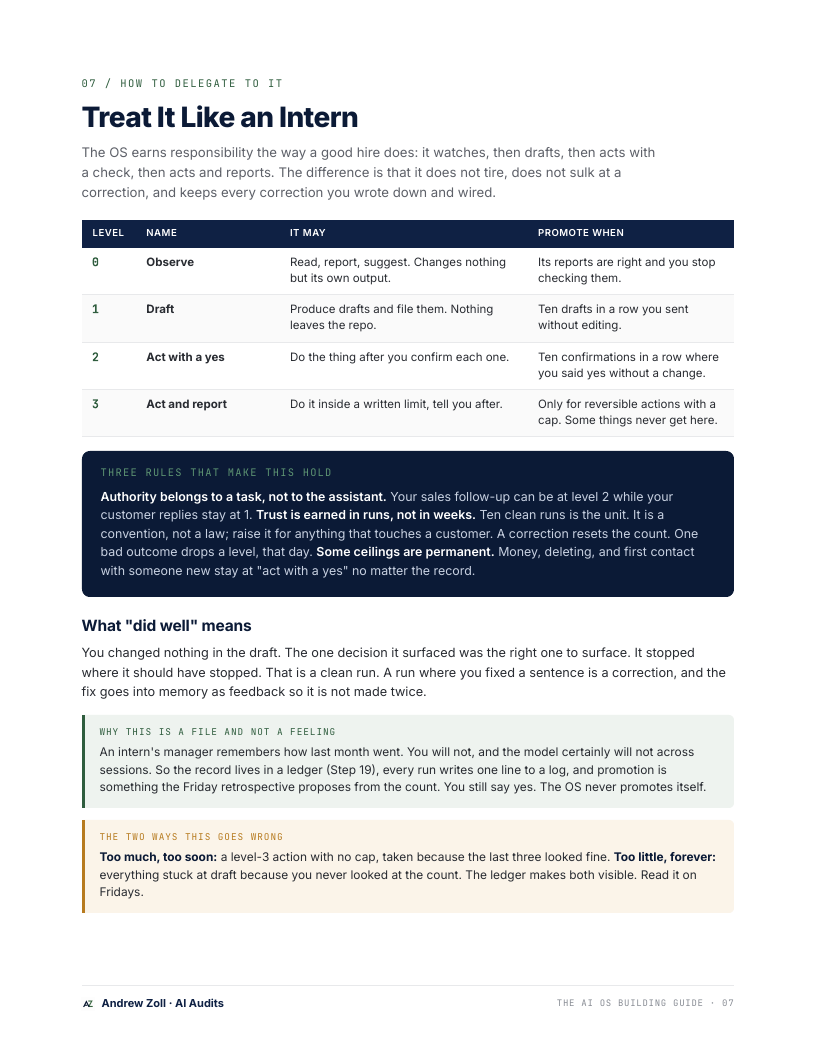
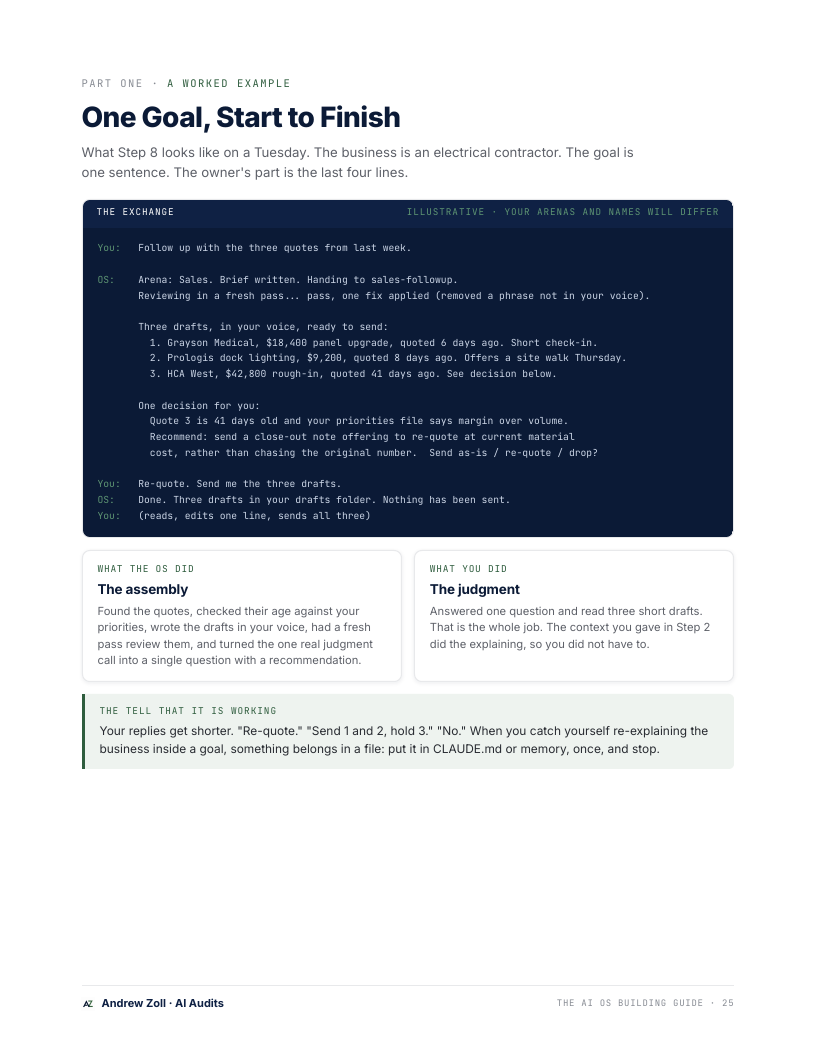
You hand off goals in plain English and approve the output. It earns more responsibility as it proves itself.
This AI OS is helping me a ton. Saving so much time on identifying actual constraints per individually restricted accounts. It is also helping me identify specific documents to load into my system, so I have them on record as informing my models and process. Thank you!
A 63-page PDF with twenty-two steps. Each step is a teaching page and a full-page prompt you paste into Claude Code, plus a proof: a cold restart, a live commit, a file appearing on GitHub. You end with a personal AI operating system on your own machine: a memory of your business, a chief of staff that returns decisions, your documents and tools connected, and guards on anything irreversible.
No. The guide assumes a business owner with no coding background. The setup chapter walks through installing the tool, and every technical step is a prompt the tool runs for you while you say yes or no to what it shows.
A paid Claude Code plan, a free GitHub account, and a computer that stays awake. About one afternoon for Part One, an evening for Part Two, and Part Three spread across a week.
Checkout runs through Stripe. Your download opens on the next page, and your receipt email carries the link. Updates to the guide are free: the download link always serves the current version.
No. One payment, one file, yours to keep. There is nothing that stops working if you never talk to me again.
The guide is self-guided and covers everything that runs as plain files. Building it together adds me on your machine for the parts a guide cannot ship: scheduled jobs that run unattended, gates that check outbound before it fires, and a live dashboard. It starts with a short call and is priced per engagement, from $5,000.
No. It is a digital download, so all sales are final. If a step fails for you, write to andrew@andrewzoll.com with the step and the error and I will help you through it, and the guide gets fixed for everyone in the next version.
I built this OS for my own businesses first and have run them on it since. I am a software engineer working on AI systems, the founder of Veritas, a citation verification service for law firms, and the founder of FieldCommand, a CRM for electricians. The guide is the method, written down after the first live builds for other operators. I live in Colorado with my wife and four children.
Files are truth. The operator decides. The machine runs the work and keeps its own state, every session, every commit, on a trigger instead of on memory.
Get the guide, $2,500 →